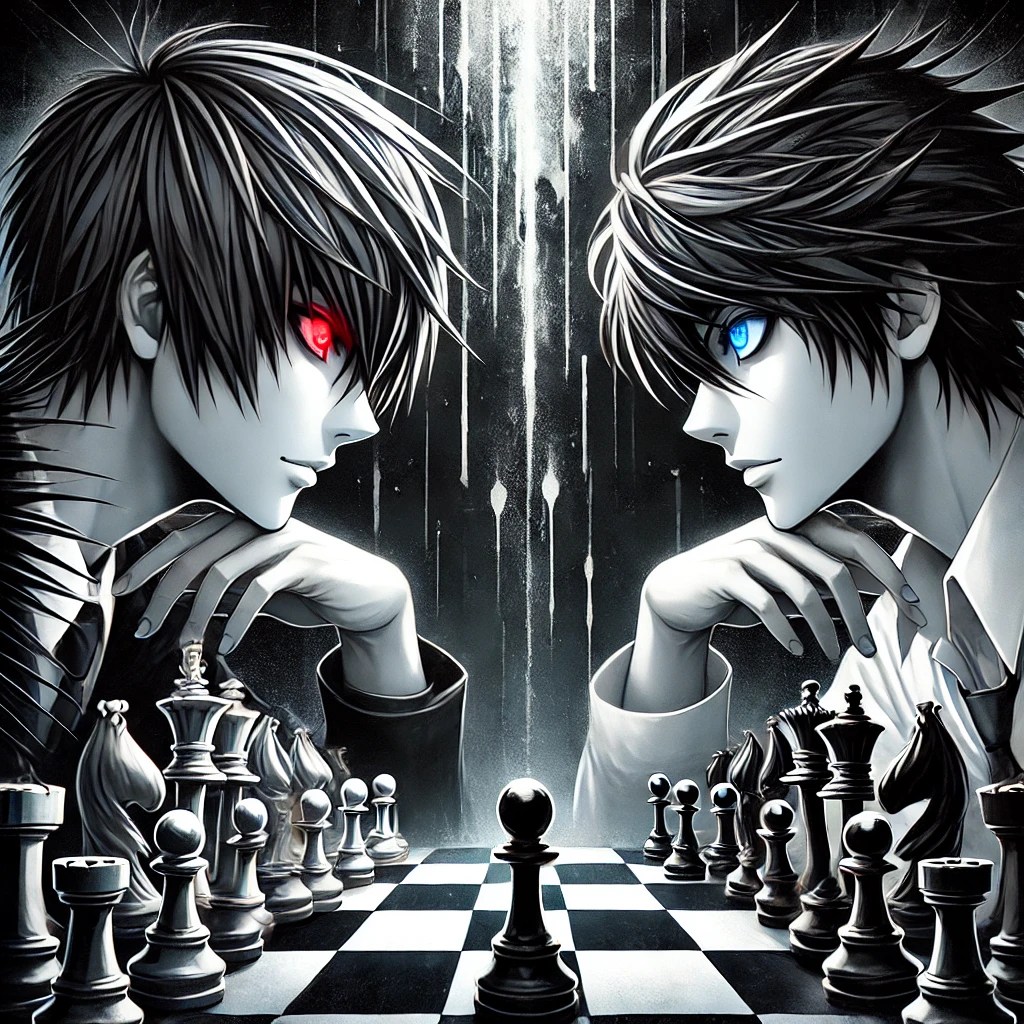
From the Universe of Death Note.
Who amongst us has never mused about a life shielded from malice and sorrow? We like to imagine a realm where sunlight reveals only gentleness and fellowship, free from the lurking talons of envy or avarice. In those moments, as we imagine conscience and willpower squaring off in the ring, we inevitably pause, because it’s precisely in such interludes that we realize, with an unsettling clarity, just how closely, how uncannily, we mirror untamed, wild beasts.
Still, entertain this idea: what if a solitary human being were somehow gifted a fragment of godhood—a single, uncanny ability to decree, within a span of forty ticking seconds, that any “evil” soul on Earth must relinquish its hold on life? Light Yagami, known in his world as Kira, inherited precisely such a burden in some parallel cosmos. To his eyes, humanity loomed like a herd of predatory beasts, legitimizing cruelty under the thin guise of laws and social niceties. In that universe, and much the same would be found in ours, the condemnation of criminals by a hidden, all-powerful hand appealed to a retribution-starved society, as though we could sign our moral burdens away to the first deity offering free redemption. When Kira wrote names, the people cheered on not just for divine punishment but for the seductive thought that at last, here was a champion who would strike down evil in an instant, whilst our own skeletons remained safely tucked in shadows.
But Kira’s passion soon exploded into a conflagration of arrogance. For he became emboldened by his newfound power, and imagined himself an omnipotent surgeon, slicing away at humanity’s moral decay name by name until only meek shells remained. Indeed, one can not deny the truth slumbering at the feet of his premise: at our worst, we do savage one another, whether by outright war or the subtler poisons of deceit, greed, or vanity. Some amongst us commit atrocities without even a hint of remorse, offering a grotesque reminder that beneath our genteel smiles lurk ancestral fangs. So it is tempting, on some gut level, to see Kira’s cause as righteous. If you peel away the delicate layers of our civility, perhaps you find a species that might indeed be improved by a swift, brutal remedy. Yet it is exactly this flicker of recognition—this willingness to nod in uneasy agreement—that makes Kira’s ideology so dangerous. He promises a seductive solution, an authoritarian lullaby to hush our darkest terrors.
For deep in our marrow, we ache for a savior who will free us from carrying the crushing weight of moral deliberation. It is profoundly difficult to stare evil in the face and remain gentle, especially if that evil has torn your family or your world apart. Even those who trumpet the glories of autonomy can crumble when confronted by monstrous wrongs. In that moment of despair, a figure like Kira, armed with unassailable might, becomes deeply alluring. Who would dare say to him, “Please, do not punish the man who violated my daughter” or “Spare the murderer who ended my father’s days”? The grief we harbor demands retribution. And so our seething anger can blind us to the hidden cost of placing life and death in a single, all-powerful hand. We need only glance behind us to see why this is so dangerous. Our history is a crimson chronicle of violence that stretches from vast wars to the intimate brutality of personal vendettas. A leader like Kira steps forward, and whispers comfort to our fatigued minds: “I will avenge your losses. Let me exterminate evil so you need never sully your conscience.” We sigh in relief, grateful to be rid of that moral burden. Yet in giving him the reins, we invite the same savage impulses to turn on us. Let no one feign ignorance: tyranny evolves precisely because we yearn to unburden ourselves from horrors too weighty to bear. It is a paradox of our humanity that we cling to freedom in one breath and submit to an iron will in the next. And here, in this chasm, appears L Lawliet, otherwise known as L.
L’s perspective, though stony and clinical, served as the moral theorem. He reasoned that justice cannot favor an individual’s inflated sense of righteousness. He demands that justice rest on firm principles rather than the whim of a single mind. Even L’s brilliance, however, does not grant him infallibility. He misjudged how profoundly Kira’s brand of justice could electrify a populace hungry to feel safe, to feel righteous. For if indeed we are beasts, we rush toward whichever muzzle can promise victory, sometimes forgetting that the muzzle can also bite.
In the short run, Kira’s approach triumphed. But that victory bore the seeds of its own undoing. Enchanted by the belief that he was anointed to cleanse the world, Kira failed to recognize his own reflection in the villains he erased. Staring into a dim mirror, he saw only silhouettes, missing the fact that he was just as tangled in the darkness. If at first he cut away genuine tumors, it did not take long for his scalpel to drift beyond curing the body, slicing instead at anyone who threatened his supremacy. In chasing an absolute ideal, he stepped into the role of the very monster he despised.
Breathe deeply, and let’s slice the heart out of this matter: if Kira represents a cure, then it is one that demands a tremendous sacrifice. His vision of righteousness is carnivorous, devouring both freedom and dissent. What use is a world scrubbed of crime if it starves the human spirit? In the end, you are left with a sanitarium masquerading as utopia—a neatly arranged graveyard where no one dares speak unless it echoes the decree of the self-proclaimed god. L, for all his eccentricities and childish sweet tooth, fought for a principle larger than any single person: justice as a constant, not an instrument of tyranny. But L’s principle, while lofty, crumbled against Kira’s swift promise of deliverance. It is perhaps the saddest joke that we want a benevolent hand to guide us but recoil at the idea of subjugation. We want ultimate certainty but cannot stomach the face of total domination. We become hamsters on a squeaking wheel, both longing for and dreading the notion of an unstoppable arbiter. And if we find ourselves choking on these truths, it is because they cut so close to our deeper instincts. Perhaps the real heartbreak is that, on some level, we know exactly how easily we might slide into Kira’s world. The line between victim and aggressor is a hair’s breadth of circumstance, whereby a single tragedy ignites a thirst for vengeance. One might even crack a grim smile, picturing how quickly we would scribble in the dreaded notebook if only we had the chance to wipe out the horrors that keep us up at night.
If there is any single thread that most clearly illuminates Kira’s essence, it is his conviction that true justice can be manufactured through fear. There is something both starkly honest and terrifying about that belief. We have all, at some juncture, glanced at the news or read a history book and wondered how many atrocities could have been prevented had a higher power intervened with decisive violence. Thousands, no, perhaps millions, of lives might have been saved if one unstoppable hand had quietly removed a handful of despots, zealots, or warlords. The logic is cold but compelling, not only that the logic draws to a discomforting fact about humanity, and it is that sometimes the only language our savage hearts heed is raw force.
Indeed, this is where Kira’s greatest allure originates. He embodies a solution so brutally simple that it flattens the complexities of moral life. Kill those who transgress, and keep killing until no one dares to transgress again. It is the same logic as countless oppressive regimes throughout human history, yet with a divine twist—Kira’s reach is supernatural and his identity is concealed. He does not need to build prisons or armies; he scrawls a name and the deed is done. In so doing, he bypasses the messiness of trials, the uncertainties of evidence, and the burden of empathy. It is a cosmic short circuit that enthralls anyone who has ever felt crushed beneath the weight of systemic injustice. Paradoxically, Kira’s stance also exposes the hollowness of our constant longing for a single righteous leader. We often imagine that if we only found the “right” person to place at the helm, the storms of human malice would subside. But Kira was, by all accounts, an otherwise ordinary young man. Yes, exceptional in intelligence, but hardly a being of transcendent moral purity. Yet within weeks of receiving his power, he was not only murdering criminals but also targeting those who stood in his way. Did the power corrupt him, or did it merely reveal the corruption that lay dormant in his heart? It is a question that gnaws at the fabric of our own self-assurances. We prefer to believe that we are safe from tyranny as long as we pick our leaders carefully. Kira reminds us that the seeds of tyranny lie in everyone. That is the potentiality of corruption dwells in each of us—those long gone, those now living, and those yet to enter this world.
And that is the universal tragedy. Had the same notebook found its way into another pair of hands, the outcome might have been equally dire. The real horror is not that Kira was unique, but that his transformation seems almost inevitable. Looking around at our flawed world, who would not at least contemplate scribbling a name or two for the sake of justice, especially if no one could trace the act back to us? The moral line we like to think of as unbreakable is more fragile than we dare admit.
Kira’s path also underscores a darker insight into freedom itself. In principle, we cherish the idea that free will is an ultimate good—everyone must be allowed to choose, even if the choice is disastrous. But when we bear witness to the monstrous acts committed under that freedom, we start to doubt our convictions. We begin to ponder that maybe the world would be better if we traded some measure of liberty for guaranteed security. Kira wields that trade-off like a blade: obey the moral code hereby decreed, and you live unthreatened; step outside the marked lines, and your life is forfeit. The deeper question—perhaps the one that truly unsettles us—is whether that arrangement might actually work, at least for a time, to slash crime rates and bring about an eerie semblance of order. A society built on terror can function, after all, but the cost is humanity itself.
It is in the silent acceptance of that system that Kira finds his greatest supporters. Many of them do not identify as villains or criminals; they are ordinary people exhausted by the cruelty around them. They see Kira as a necessary evil, if indeed he is evil at all. They say, “Maybe it takes a monster to slay other monsters.” It is a sequence of reasoning as ancient as the first warlord who promised protection in exchange for allegiance. Yet history teaches us again and again that once that monster’s appetite is sated, it seeks new prey. The separation between “wicked” and “dangerous” soon vanishes. The journalist who dares to question Kira’s methods, the detective who inches too close to the truth, the innocent bystander who suspects foul play, each stands in the crosshairs the moment they become inconvenient. And how easily we might, in some hypothetical scenario, remain silent, telling ourselves that as long as we are not criminals, we have nothing to fear. We do not realize that, in Kira’s eyes, “criminal” becomes any entity that disrupts his divine mission. No one is safe in a world where the judge, jury, and executioner is a single entity reliant on secrecy..
Yet we cannot entirely brush off Kira’s rationale, either. In the grand chessboard of moral quandaries, he occupies a shadowed seat that we cannot simply label as “pure evil” without nuance. His solution, whilst indeed horrifying, addresses a legitimate despair: the world is soaked in cruelty, and every system we have tried to impose—law, religion, diplomacy—has failed to uproot it entirely. Kira’s method, simplistic though it may be, resonates because it promises swift results. War criminals, terrorists, and serial murderers vanish overnight. The price is dreadful, but for some, that trade is all too tempting. If we are honest, how many of us would condone such a system if it meant our loved ones were safer?
L, for his part, stands as the questioner of that premise, the scientist refusing to accept that salvation can ever be found in a single, all-empowered judge. We watch them clash, and we see within that clash our own conflicting impulses: a longing for decisive action that crushes evil in an instant, versus the more laborious path of justice that demands due process. And just like in our world, it is not always clear which path truly yields less suffering in the long run. Kira’s body count is tangible and terrifying, yet the hypothetical body count he might have prevented is simply unknowable. Perhaps the biggest tragedy is that both Kira and L reflect different facets of our collective identity. We want to believe in a rational world, so we side with L’s careful, measured approach. Yet in the pit of our stomach, we also yearn for immediate revenge, the sort that Kira serves up, red pen and all. That is why their story resonates so powerfully. It forces us to confront the possibility that in times of extreme desperation, we might sign away our moral codes with hardly a second thought.
And so it is that Kira, though defeated in fiction, haunts us like a specter. He reminds us of how deeply we crave order, how unflinchingly we might rally behind a savior who promises to deliver us from horror, and how blind we can be to the serpentine path between savior and tyrant. If there is one note of levity, it is perhaps the cosmic irony that such a slender instrument—a notebook—could unmake the architecture of law and democracy. Imagine if your local librarian held that notebook, quietly reading newspapers and deciding who would vanish next. The absurdity might make us laugh, but beneath that laughter quivers a real fear: what if such an outcome is not nearly as improbable as it seems?
The most unsettling revelation might be that Kira’s logic is not alien, not the ravings of an evil genius, but rather a bold extension of thoughts many harbor in secret. We recoil at real-world atrocities yet find ourselves powerless to end them. We see criminals set free on technicalities, watch tragedies unfold despite our so-called advanced systems of governance. And part of us wonders: if only a single, brilliant force could be unleashed upon the plague of human malice, would it not be worth the moral compromise? Yet, deep in our collective memory, we recall how such compromises tend to unravel. One name leads to another, one justification for murder gives rise to the next, and before we know it, we are condemning people for their doubts, for their questions, for their inconvenient presence. The horror story becomes cyclical, mirroring every dictatorship that began with grand speeches about liberation only to descend into fearsome repression.
In the end, Kira’s ultimate failing is not that he was malicious from the start but that he believed himself uniquely qualified to wield absolute power. His downfall is a somber reminder that no human mind can bear that weight without fracturing. The more he scribbled in that fateful book, the more he reshaped reality according to his will, the deeper he sank into the delusion that he was a god. And perhaps there is no sharper reflection of human folly than that: an ordinary person clutching at godhood, convinced they alone can deliver the species from darkness. We who watch from the outside can only ask ourselves if we would fare any better. Would we have the humility to tear such power from our own hands before it corrupted us? Or would we, like Kira, justify each new name as a necessary correction to an unjust world? It is a question that pricks our conscience and leaves us, if we are honest, feeling uneasy. Because in the darkest corners of our mind, we may not be so sure that we would walk away, either.
In the hush left behind by Kira’s story, we might still cling to hope that our better angels can stand guard against our darkest impulses. But that hope, fragile though it is, must contend with the reality that the seeds of a Kira slumber in us all. To remain vigilant is both our burden and our saving grace. Whether we choose to laugh grimly or weep quietly at that truth is our own affair, but let us never say we were not warned.
 Dr.MOG
Leave a comment