Matthew: “So, in summation, if temperatures had already been elevated to high degrees, even if an exothermic reaction occurs in the system, there would be no change in the overall quantity of microstates in the surroundings?”
Asked Matthew in his typical, exasperated voice. His yellow T-shirt was hard to miss by the study lounge’s residents.
Jane: “Well, not quite, the change would be smaller, but not really zero. At least, that’s what you need to recognize as true for this level of chemistry. Next year, you will begin to investigate the curious nature of such simplifications and why they may not reflect a holistic portrait of chemistry.”
Responded Jane. An upperclassmen biology major who heads the chemistry tutoring department.
Matthew: “‘Next year’? You must be joking! There is more of this hell?”
Retorted Matthew, clearly annoyed by Jane’s revelation.
Jane: “Sure! You intend to pursue a bachelor of science degree in Psychology, which means you will need a year of chemistry and a year of biology to satisfy the graduation requirement.”
Matthew’s eyes began to reflect bottomless rage…one that is due great growth in a few seconds.
Nick: “Arthur! Please join us.”
Yelled Nick, an…interesting friend of Matthew.
Matthew:”Oh boy…”
Angrily whispered Matthew.
Arthur: “Hello mates! Jane, it’s been a minute, how has life been treating you?”
Jane: “It surely ha…”
A sharp voice interrupts Jane.
Nick: “Have you studied yet? I am terrified of Sean’s latest email; he seems eager to have us train for essay questions, which, frankly, means you won’t be seeing the multiple-choice section.”
Asked Nick. Appearing to sweat past what should be humanly possible.
Arthur: “I have seen many educators appraise Essay questions as the utmost e…”
Matthew: “Just respond to the simple question, ‘mate’! He did not request a philosophical perusal on the caliber of Essay questions.”
Arthur: “Matthew!” Glanced Arthur at his classmate. “Why is Mr. Simpson in such a fiery mood?”
Arthur, with a smile, shifts his attention back to Nick.
Arthur: “No I haven’t studied yet, Nick. I have been busy planning my trip back to England for the summer.”
Jane: “Oh, are you going–”
Nick: “Oh man! I was really looking forward to seeing you around in the summer.”
Arthur: “So have I.” Arthur said somberly “but I am terribly longing for my parents’ company.”
Jane: “Aw! Are you–”
Matthew: “Need a mommy’s hug little man?”
The familiar is not often horrible, that much is known. Nonetheless, the norm of Arthur and Matthew is in dire need of aid.
Arthur’s voice geared abruptly into conflict.
Arthur: “Transitory beings of our like can never hope to experience anything but unfathomable despair in loneliness. An isolation from a mother’s soft hug, a father’s comforting smile, the warmth of a loving sister and the endless joy of friends is an assured path toward self-destruction. Yet, burdened by the immaturity of youth, I had once believed my future, similarly to you, existed outside the parameters of my home and I could not be bothered to scrutinize the notion of alienation, for I thought such sacrifice is inconsequential compared to being able to achieve my dreams…how I wish I had been wiser.”
Matthew: “I can never accept the country of my birth to also host my grave. Ha! I could not be less surprised that your younger form is indeed vastly wiser than this erudite transformation you call adulthood. A valediction from comfort is the singular way to breed appreciation into what had been important, and should, as opposed to ushering regret, urge you to succeed and return so you may treasure what was once a meaningless possession.”
Arthur: “Such a statement is merely symptomatic of being naively idealistic. In a utopia where my former possessions endure eternally. Certainly a return, post achieving my goals, would be all I crave. But, how may I return when the very facets that governed my past happiness are finite, and may, very likely, not exist when I finally celebrate my success? To what end are we then driven toward greatness?”
Jane: “Hey maybe we ought to–”
Matthew: “Well, the psychological sciences have wrestled with such queries for generations and, following thousands of publications, the scientific community remains ever divided. Adler believed power held the answer, Freud postulated pleasure as the true response, and Frankl advanced us toward the pursuit of meaning. But me, the lowly undergraduate Matthew? I believe it goes beyond a few syllables and is in fact a long, long list that ties in with another question: What makes us human? My intrinsic drives toward success are precisely the characteristics that define my unique humanity. Such motivations include: seeing my mother joyous before her son’s enormous wealth, releasing my father from his duties and finally forcing him to drive and dress luxuriously, and finally, you recall Nichole from the Physics lab?”
Arthur: “Uhm, sure, the redhead?”
Matthew: “Bingo! The redheaded angel whom beauty rendered every fiber of my being paralyzed each time I saw her. I would like to add her to my list of reasons as well. See success provides my life with meaning, grants me power, and boosts my confidence in asking a lady like Nichole to a date. That does not unequivocally state that only through success can we experience any power, meaning or love, but we hope to conquer the world so that others, especially loved ones and…potential loved ones, may respect and crave us further.”
Nick: “Wait, isn’t Nichole–”
Arthur: “Wouldn’t that be the shallowest approach to defining success? Fantasies of power and romance are the luxuries of so few, and should not, least of all to sane beings, outline the motivations of success for the entire race. A median life of seventy-two is barely enough for one to make it through school, gain a few years of experience and hope for a family that doesn’t encourage them to entertain suicide as a possible escape.”
Matthew: “I think your tiny ears closed shop when I said “unique humanity”. But to your point, that’s why to cultivate an existence of worth, one must hope. Hope that within eight decades we may turn aspirations into achievements and hold our beloveds with pride. A world devoid of hope is–”
Arthur: “Is a world of realistic expectations. Hope is an abdication that enshrines self-approbation without the slightest hint of hard work.
Jane: “And what of life but hope?”
Jane’s voice finally broke through the duo’s seemingly impenetrable capsule.
Jane: “As our schooling years conclude and bring the few seconds of celebration upon us, we have already crossed two decades attempting to learn of our varyingly unique worlds. By then we are still clueless of what dress our futures would wear…for many it’s green and inundated with uncertainty, but not too gloomy as to encourage an abrupt departure. While for others a black dress riddled with disappointment and mundanity seems imminent. Blue is for the lucky ones who get to dance with a mate of their choice within a career of dreams. Next we see Red, for those who had to bid farewell to loved ones earlier than most. Encumbered within each distinct group is an eternal hope that our futures might swap their dresses for a white one.”
Nick: “and what would white mean for you?”
Arthur: “White is for the reckless masses who would rather hope for the impossible rather than work for the probable.”
Jane is beautifully drawn. Her scalp is shyly hidden underneath thousands of stands of straight black hairs, and small ears asymmetrically placed around a circular face. Her eyes carry a delicate brown shade that are now challengingly dilated at Arthur’s.
Jane: “White is for the courageous who stood uncrushed despite life’s immeasurable weight. It’s for those who preserved through defeat and betrayal. For those who buried their beloved and moved on with remembrance. White is not the absence of pain, it’s what remains after you thoroughly mix blue, red and green lights. Its presence is the precise evidence that pain had been faced, and despite the scars it left, the individual remains alive to thrive further.”
Matthew’s former disgust at Arthur withered before Jane’s words. If not for his former confession about Nichole, one could almost suspect his starring, and the smile it accompanied, to be symptoms of love.
Nick: “But, one could soundly argue, using your logic, that those dressed in black are doomed to perpetual suffering. Should they dare to hope as well?”
Jane: “No one is condemned to suffering in perpetuity. No matter how calamitous existence may be, we should all hope.”
Arthur: “If only the nature of the world mirrored your dreamy words, Jane. Any dosage of Hope could render us complacent and dysfunctional. Facing today’s challenges requires sturdy reasoning that unfairness is rampant and only through being realistic about the truth of what we are given can we positively prosper. Think of the homeless with no home to come back to after a lengthy, dreadful day, or of three siblings who must share a crumb of bread amongst themselves to quell what they can of hunger, and of the countless behind bars for reasons beyond their comprehension. Ponder those born limbless, sightless or without voice…Why must we trick them into hoping for what we know is an impossible attainability?”
Jane: “Because we need not be perfect in order to be complete, future psychologist. Life is indeed unfair, but those born with an absent sense can conquer the world ten times harder than many who were blessed with their perceptions intact. The impoverished will indeed battle stronger demons than some of us, but their chance of success is no less debatable than yours. To murder hope for those who were simply born into less is to mark our world a melancholic hell.”
Nick: “No one is saying that hope and work are antagonistic, right man? Like really, you can hope for the best and work with whatever you have for the best you can possibly have, right?”
Matthew: “I concur. Our ability to work is inspired by having faith that however inconsolable the circumstances may currently seem, we hope that through adequate functioning we may land in sunnier grounds.”
To push against a natural consensus is an unnecessary burden that so many elect to abstain from indulging. One should appreciate the humanity of Jane’s view on hope, and, simultaneously, be utterly disillusioned with Arthur’s pessimistic outlook.
“Entertain me, Arthur.” Said Matthew, attempting to retake lead of the communication against his classmate “What is the alternative here? What is the replacement?
Arthur: “I…I do not know. To advertise hope as a savior from desperation is tantamount to assigning wild lions to guard us as we slumber in open tents. Hope might have saved a deprived someone somewhere, but the overwhelming contingent of those birthed into dismay have no possible escape. Life seldom permits transcendence amongst varying socioeconomic statuses, nor do its scars strike the disabled less sharply. We exist to suffer unconditionally, and success is not an antidote to that pain, nor is it more likely with Hope.”
Matthew: “You may hate concessions, Arthur. Perhaps the idea of you ever being wrong is not well programmed into your robotic demeanor. But, you are here because of hope. No reasonable person departs their home in search of opportunities without being hopeful that they will unearth precisely it which was absent in their world of comfort.”
Arthur can only smirk before Matthew’s proposition. One can only imagine how unsettling it must be for the arrogant to detect the irrationality and contradictions within their logic.
Arthur: “Well, perhaps that is a notion whose validity may only be determined as my life progresses. For now, am afraid I must bid you all goodbye as I had promised to be elsewhere at this time. I wish you all a future drizzled with white dresses. See you all on Monday.”
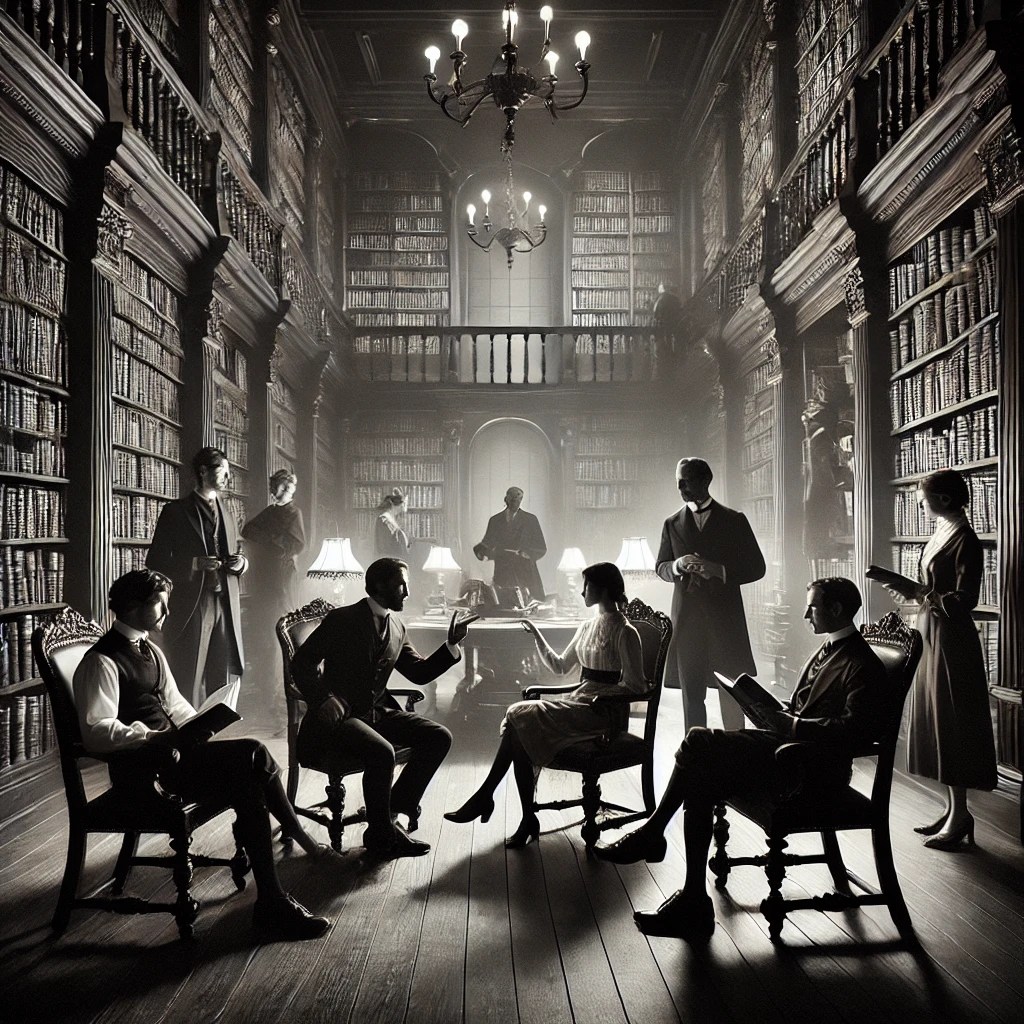
As Arthur begins walking toward the library’s door, the audibility of his footsteps became ever more distant and lost between the muffled chatter of Nick and Matthew, Jane stared questionably at Arthur’s direction.
Jane: “Such a prideful man. There is more to this than he is willing to admit.”
Gently whispered Jane, addressing no one in particular.
Nick: Sorry? I did not catch that?
Jane’s eyes widened before Nick’s. “Nothing” She said firmly “Well, shall we carry on? We still need to cover electron shells before we can move to chemical bonding.”
Matthew: “Never thought I would miss a conversation with that punk…Sure! Let’s talk about electrons, why not? It is not like life is already too short.”
The artifact of life is a confusing anomaly. Statistically, Homo sapiens have combated insurmountable odds to linger so regally upon a planet with so few identical sisters in a cosmos of boundless possibilities. Even the notion of birth is a puzzling phenomenon, for out of millions of sperms, it was in particular only one to reach an egg and thereafter birth a unique amalgamation of qualities. As the unborn begins to form, the instinctual needs to satiate hunger, long for oxygen, or secure sleep are secured by an impeccably evolved system. Suspended in fluid, the care to conquering dreams or feeling drowned in worries about an insufficient income are not yet burdens to be entertained. Nonetheless, the struggle for survival befalls all unsuspecting newborns alike, and with a chilling cry, we signal to the world that here we have come.. For the average life span of seventy-six, we will exist to chase forbidden joys all whilst racing an eternal clock that does not break.
Each morning the right side of many humans’ brains pulses, exciting countless neurons through an unmistakable pathway to rotate their wrists. Light particles carrying the petrifying message expeditiously penetrate their glasses and trespass through the sensory receptors of their eyes; “8:33 AM” echoes the seldom quite mind of those fortunate to awake as it makes sense of the sharp positions of the wristwatch. Defied by their body, their tiredness has rendered their ears deaf to the clamoring alarms, and some had missed the morning class, all while time had raced by indifferently, as if mocking them for their endlessly varying mortal incompetence. Certainly, unlike time, we are laughably limited. Our existence is governed by seconds to which we are oblivious, moments which are wasted in extraneous matters, supported by irrational sanguine statements: “Oh I have got time.” “I will do my assignment tomorrow.” “I’ll certainly tell her next time.” “I forgot to call my mom…well I will remind myself first thing in the morning.” Unfounded utterances that incomprehensibly made us behave and strategize as if we have got eternity ahead. What an abrasive realization awaits us before long.
A second’s momentary presence is fleeting, but a transitory succession of moments has demolished ‘everlasting’ castles, ended ‘fanatical’ romances, broken ‘chained’ promises and turned ‘unimpeachable’ empires into lessons of history.
By the time we become properly acquainted with the fear of our finite existence, the last human skin will grow rigid, their bones will flock out of place, as their joints collapse wrestling the boundless weight of death. Their muscles will gradually evaporate as what remains becomes buried underground. No power will ever bring them back. That assignment never got completed, their mother never heard another ‘I love you’ by their voice, their crush never learned of their interest, their eyes will never shed another tear, their seat will always be empty, and they will never wake up again. It must have taken a little over twenty minutes for you to get here, to this line. If you are twenty years old, and sleep seven hours a day, you are only able to re-read this text 1,362,667 times before you become a mere memory. I wonder if you would be able to tell that your last laugh, was the last laugh.
In essence the relations of mortality, hope and success are so embedded with the human mode of being they are almost impossible to separate, let alone navigate at an age where much of life remains unexplored.
Yet…
Is there truly a paucity of appreciation of our many fortunes? And is hoping truly the right approach to enduring lives so immersed in pain?
Can we be enlightened with hope in spite of the constant disappointments?
Perhaps we ought to work with realistic expectations and abandon hope in order to attain functional living. Yet, what would break in us if we truly abolished hope? Maybe a better question is what would even remain?
 Dr.MOG
Leave a comment