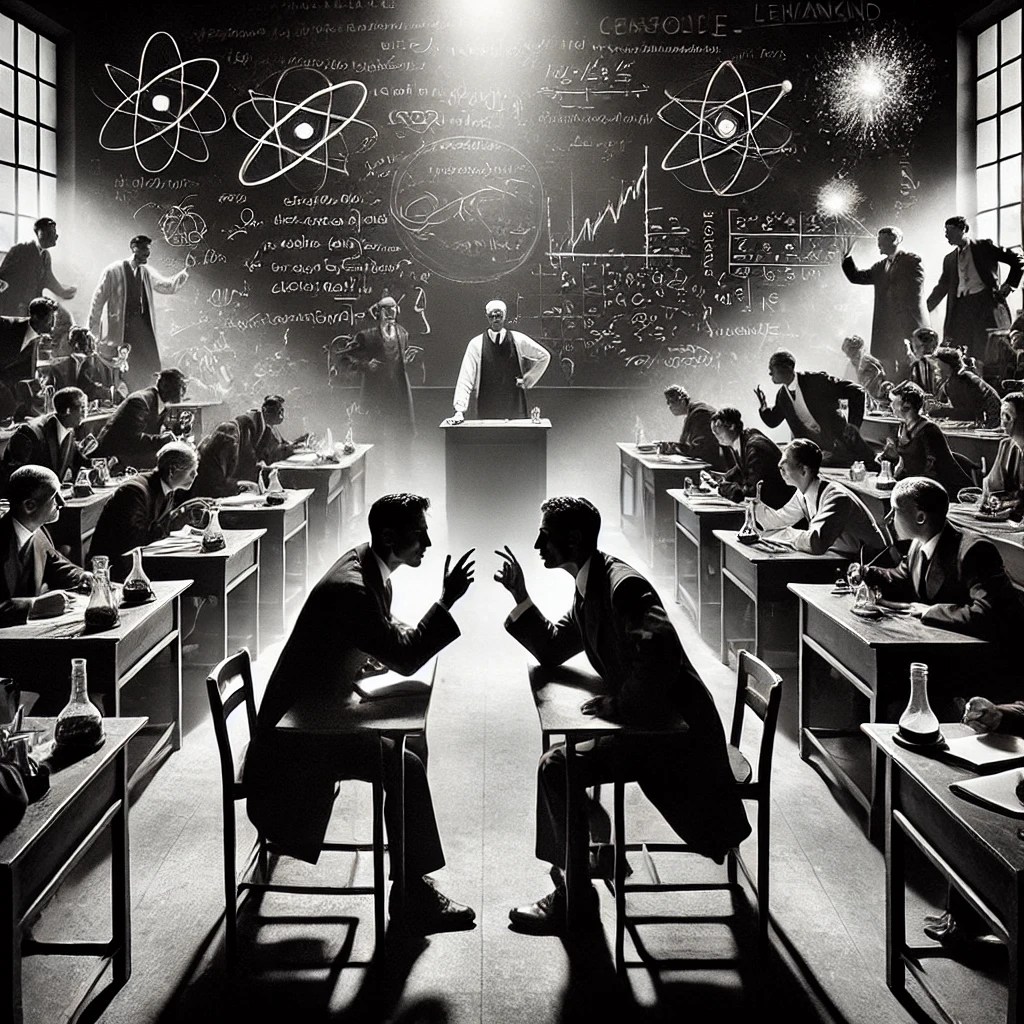
Prof. Sean: “I can truthfully tell you that the final exam will be nothing short of devastating to those who have yet to take it seriously. Realizing that you can’t fathom a concept or apply an equation on test-day is a bit late. So, I suggest revising the content thoroughly and using office hours for any questions on the text.
Though uttered in good faith, Sean’s remarks generated noticeable unrest in an already anxious group of scholars.
“What a great dose of encouragement!”
Yet, through the classroom’s inaudible chatter, a singular voice invaded Sean’s ears.
Matthew: “I cannot wait to let the better part of my days wither away to memorizing the excruciatingly long, and equally fruitless, laws of thermodynamics. Truly, what use is knowledge if I am to dispense of it after the course’s inevitable end? Wait, that was rhetorical, but contemplate this: I aspire to be a clinical psychologist, when will I ever, including on career-relevant assessments, be required to draw an electron configuration?”
The voice belonged to Matthew, a first-year student who’s known to host a charmingly social persona, which is seasoned with impatience, impulsivity and an iota of rudeness .
Prof. Sean: “Oh?”
Sean glares angrily at the youngster’s degrading remarks
Prof. Sean: “Chemistry and Physics provide the blueprint for the practical functionalities of the universe. Disregard their virtue and even the minutest of tasks, cooking for instance, becomes nearly unrecognizable. So, what subjects would you have replace such vital courses?”
Matthew: “You mistake me, Sean.”
It’s Matthew’s signature is to do away with titles. Gaps of intelligence or strength are not known to intimidate him.
Matthew: “I did not question the sciences’ evident implications; I am only challenging their significance on an undeclared freshmen’s academic schedule. Aside from future chemists, a formidable portion of the articles I am forced to swallow will be of no real-world use the moment the course is dropped from my Moodle page. Now, to answer your question, I would say in a reasonable world, we would have first-years explore the economical fields to learn about business management, and take a slice from psychology to learn about managing themselves. Chemistry, especially one of equal level to this class, serves only students of, you guessed it, chemistry! Even premedical and engineering graduates won’t benefit from such details, let alone a curious, fledgling freshman.”
Seldom could a first-year student speak with such precision and confidence. Indeed, his immature brain has many more years to sprout, but even the professor notes how challenging Matthew’s persona can be. Yet, none is immune to competition, and as thorough as Matthew can be, his remarks constantly seem to stimulate the undesirable attention of a particular friend.
“…not necessarily”
Enter Arthur: Matthew’s arrogant, less social, companion…as usual, this will be a long, and an annoyingly pretentious, dialogue.
Arthur: “the mere existence of the human species subsidizes the second law of thermodynamics. Certainly, the scientific nomenclature might elude the masses from comprehending its underlying truth at the psychological level, but it does nothing to abate its application.”
Arthur’s tune is quite distinguishable. Always generated with serene authority, and yet perpetually irritating due to its overreaching arrogance.
Matthew: “Curious, Arthur, do you sincerely see a realm of applicability to Claudius’s idea of disorder on the human dimension? I admire the enthusiastic approach to merging Chemistry with Psychology; however, I only find it nearly impractical to generate any meaningful plausibility.”
Arthur’s eyes lock with Matthew’s, almost pushing against one another.
Arthur: “The law, at an elementary level, suggests that as one travels forward in time, they shall witness the overall entropy, or degree of disorder, of any isolated or closed system to either increase or remain static, correct?”
“Human societies exemplify this very effect in a myriad of ways, and although most effortlessly in their daily behaviors, it can also be observed in actions requiring a marginal degree of meticulous effort. Observe, for instance, the course of our anthropological evolution, as variations amongst us became more pronounced, we waged wars of superiority as opposed to developing mediums for unity. Warfares ruptured the original comprehension of the homo-sapiens genus, sundering it into a zillion other sub-races. We have the white, the black, the sexually straight, the sexually deviated, the Arab, the Muslim, the Christian and each last name of those lists secretly wishes an iota of ill to befall the other, or, in entropic lingo, longing for an increase in disorder. The further we developed, the more isolated those categories became from each other, and even in modern summers, we celebrate the individual triumphs of a race, in other words, the extinction of the ‘other’. Here, the ‘other’ is a concept devoid of concrete parameters, allowing it fiction-like expansions, for example: to a functional population of whites in the 17th century, the blacks espoused the definition of the ‘other’, which rendered them enslaved and murdered, and to a random individual their ‘other’ could be any recently promoted co-worker, which would render the oblivious co-worker hated and avoided. You see, there is war between cultures, sub-races and religions and war within each of these communities. Why do you propose our instincts impel us toward aggression to the ‘other’? Psychology would suggest greed, power and sexual desires to be amongst the core elements of the answer, to which I concur. Furthermore, I find the biological justification of territorial superiority and predation to be viable tenets as well. Yet, the laws governing molecular behavior may too possess a vital element to the overall truth about us, about earth, and this inexplicable paradox that we term life.”
Frankly, the remark is both foolishly ambitious and confusing. How can any delegate of reason forgo the integral facets of humanity and elect to treat societies as an ‘enclosed systems’?
Matthew: “Such a daring claim requires formidable backing, Arthur. Human life is a complicated notion that traverses several dimensions of being. Why we pursue a specific outcome as opposed to an alternative one spawns the inquiry of “free-will” which in and of itself is dependent on countless variables. Emotional states, varying degrees of awareness and even forgettable details such as weather conditions could pose a significant alteration of one’s ability to think and thereafter generate a decision. On the contrary, atomic operations are not human, not to mistakenly mean them simpler than us, rather plainly different. The laws of physics and chemistry were obtained experimentally, under observant eyes and controlled environments, their nature is antagonistic to the randomness analogous with our mood swings, thought traps and impulsivity.”
Arthur: “Funny how you could define it, yet still miss the keyword. What you just described is chaos. Also, this seeming complexity of ours is but a shallow mirror reflecting our own incompetence. Since the sole species desperate enough to understand the humans is just the humans, ‘complexity’ is a contraption we invented in defense of our incapacity to fathom cosmological eccentricity and to project basic feats as actions requiring profound contemplation. Factually, there is no deeper meaning behind the majority of acts, they are merely instruments through which our utmost inner identities are manifested…that’s not “deeper meaning” it’s just instinct. Thereby rendering the adjective “complex” a classic maneuver to escape an otherwise uncomfortable mental confrontation. We are but a reverential molecular construction and as a whole organism, we too obey an identical set of rules to that of atoms, making it rational to view our tendencies as the mere microscopic affirmations of our internal selves not just simply desiring, but also necessitating, chaos.”
Unlike Matthew, Arthur’s flowery language often obscures his delivery of ideas, and often, he fails to statically focus on a singular point. Preferring to instead oscillate between ideas, which while sensibly linked in his mind, are of no critical relation to most external spectators.
Matthew: Your proclivity to digressions is just a wonder, man! Chiefly, you enthrall me by advertising a veiled relation between chemistry and psychology, then you rant about racism, which while a consequential idea, fails to deliver your point! Worse yet, now you claim that nothing is complicated, rather ‘complex’ is an abstract which serves cowards. Now, for the sake of your seventy…seventy-five centimeter body, I hope am not the particular target of your insults. Second, just for the sake of debating, “complex” is quite a real adjective, one that also happens to reflect a cluster of human actions. See this four-thousand page textbook of rubbish about atomic integrity and what not? In each of the forty-five units the phrase ‘We have absolutely zero freaking clue why this happens’ is inscribed at least once, why? because it’s complicated for us to understand! No one is running away from a confrontation with hydrogen atoms, Mr. Complicationisforcowards.”
Arthur appeared to adjust his seating for a clearer vision of Matthew. Ostensibly bothered, but in reality overflowing with excitement before this seemingly endless discussion.
Arthur: “Certainly, an ape would be far more suggestive of a physical altercation, thanks for proving that. Furthermore, perhaps I worded my thoughts erroneously, of course, the alternative here being your underdeveloped brain simply could not comprehend my statements, but I digress. I will restate my ideas more carefully.”
“Typical.” Whispered Matthew at Arthur’s confession.
Arthur: “I meant not to classify the application of the term ‘complex’ as a hollow expression resembling only the weakness of its user, and assigning it exclusivity to cowards. I only meant that it has the capacity to sheath the cowards’ guilt from extravasating into their consciousness. As in, some do commit heinous acts, that are otherwise easily explained by their propensity to chaos, and claim them complex to avoid a confrontation with the reality of themselves being just heinous.”
This latter idea, independent from Arthur’s attempt to linking chemistry with the social sciences, seem far more permeable into Matthew’s head than formally suspected.
Matthew: “Once more I will elect to overlook your insults. I concur, there is definitely a defensive mechanism constituted wholly on framing an easily intelligible action as one of inexplicable profundity. Nonetheless, this concession does not engulf your former idea of human populations having an inner drive to disorder. Atoms pursue an increase in entropy, and that’s practically why life as we know it works! Humans across generations fought for peace, for instance, the act of slavery incited many to venture into war seeking its demise. For you to claim that human functioning is chasing a continuous increase in disorder merely speaks to your shallow pessimistic perception about humanity. ”
Arthur: “Fair enough. Let’s break it down again. A…”
CLAP CLAP
An audible clap impedes the duo’s conversation.
Prof. Sean: “Nope. Color me grateful for your defense of chemistry, but your classmates have long abandoned this discussion and I feel like am ought to join them. Another class is due to proceed in this room soon, so perhaps carry this over elsewhere?”
A quick survey of the classroom returns an almost empty room and a far quieter aura. The conversation’s intensity hijacked Arthur’s, as well as Matthew’s, ability to remain in tune with their surroundings. But, while they zealously wish to collide further, Sean’s prompt for a ceasefire is welcomed positively and the two go on about their day.
Chaos remains a common denominator in a variety of humanity’s interactions with itself and the world, hence why we often permeate ideologies that strengthen our divide and encourage greater disaster. Sadly, our only home bleeds from innumerable calamities whose sole perpetrator is the human: a creature who departs their safe habitat to induce pain by harming another of its kind, itself or the world upon which it walks. We damaged so constantly and so passionately that it blended with our mode of being, neatly eluding its recognition from ever surfacing outwardly. Yet, now as the idea dances in its familiar colors, it dares us to wonder of any alternative explanations to why we function in this imprudently peculiar way. Could it be that we are actually kinder than the pessimists frame us to be? Alas, we are too tainted by unpardonable crimes, a fact that renders generating an explanation which stars us as gentle and loving a challenging endeavor. The murder of someone’s soul, thievery of another’s body, wealth or mind, manipulation of pure emotions, and infinite other violations do highlight a sinister dimension of the human. But, perhaps we could offset the stress of evil by speaking of those who favor the equality of genders over the superiority of one, scholars who initiate donation to alleviate the suffering of children, police officers who protect the rights of citizens…but we can’t. The police aim at the innocents, genders clash at an unprecedented hostility, and billions of dollars in charities seem to leave the children buried under shattered dreams.
Must well-intentioned acts be judged by their resulting injurious consequences? Were the intentions factually pure of heart to begin with?
Could it be that we wish for an image of decency only to satisfy our gormandizing appetite for status?
That we are inherently indifferent but to the expansion of our gains, even whilst knowing that attaining such expansions would incur a fee of disorder to befall us or others?
Indeed, we are random, we happily admit to that much, but must we also admit to our chaos?
 Dr.MOG
Leave a comment